


There are 100 million white men in the United States. Every day reactionary forces are working to convince this population that trans people, people of color, immigrants, Muslims, and feminists are their enemies, and that billionaires, white nationalists, and patriarchal grifters are their friends. White men in this country are disproportionately suicidal and increasingly downwardly mobile. Yet we are continually told lies about the true causes of our problems. We are told to punch downward while the corporate plunderers of working people and the earth we call home continue to enrich themselves at everyone’s expense.
Without an equally powerful movement capable of showing white men their fundamental stake, role, and belonging in multiracial, multigender movements for a different world, we will continue to be out-organized by our opponents. Unfortunately, progressives in this country have struggled to carry out this task.
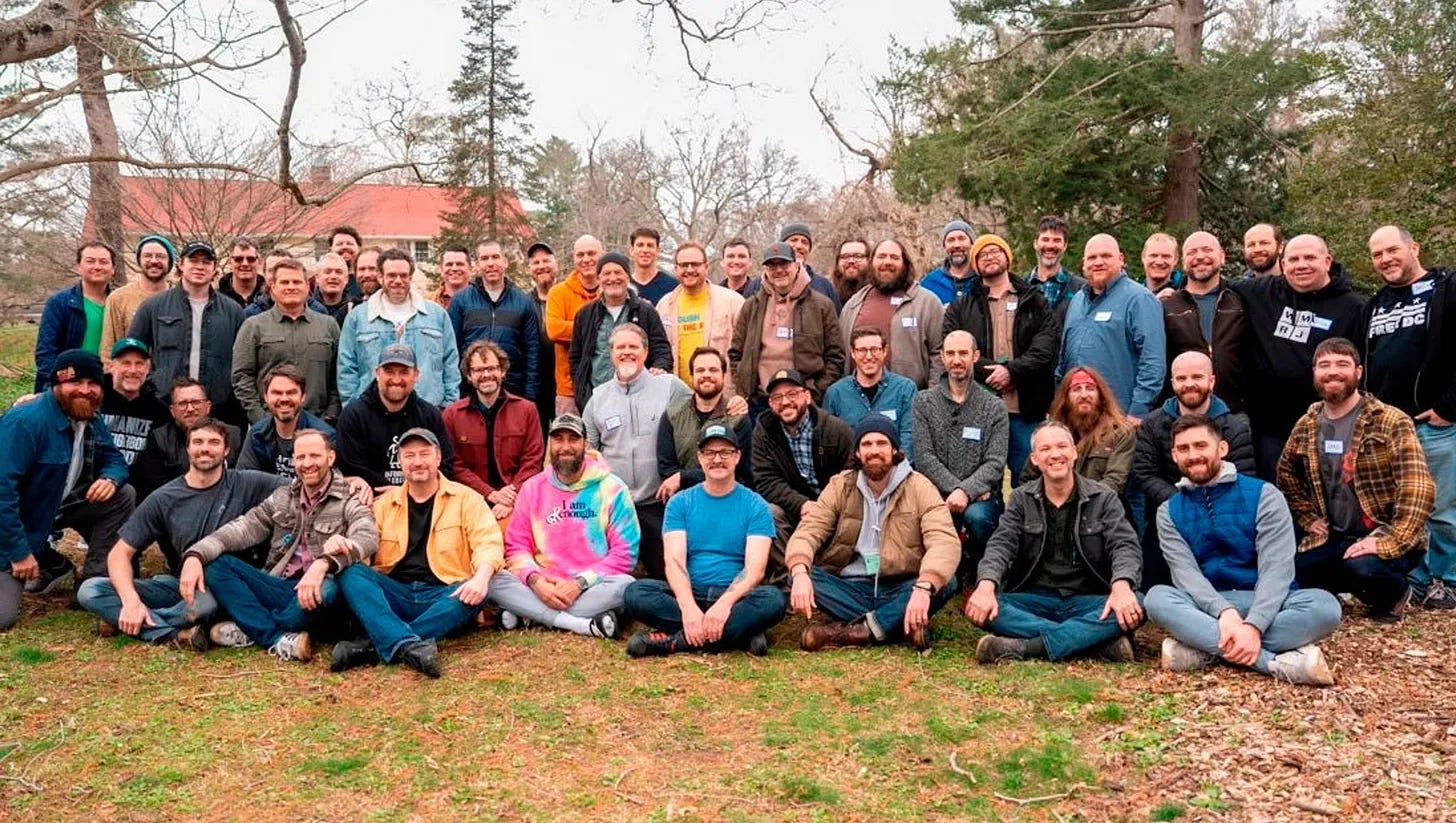
This past spring, I was invited to a 4-day retreat outside Philadelphia with 60 other white guys who are leading efforts from coast to coast to change this reality. It was hosted by Perennial Sunflower Project, an organization founded by Garrett Nieman and Otis Pitney dedicated to organizing masses of white men to fight for justice for all. A perennial sunflower both has the strength to withstand fierce winds and the capacity to return year after year. Likewise, this organization—through national convenings, fundraising, and technical support—strives to cultivate a broad ecosystem of interconnected efforts helping white men both resist the forces recruiting them into destructive causes and commit themselves to positive social change for the long-haul.
This retreat was meant to build connections between organizations and individuals doing this work, instill a common analysis of how power operates, and create space for the forms of vulnerability and community that white men are so often deprived of in our dominant culture. It included leaders from groups like White Men for Racial Justice, Working Families Party, Showing up for Racial Justice (SURJ), Highlander Center, Solidaire, Organizing White Men for Collective Liberation, Jews for Racial and Economic Justice, Up North Advocacy, Pennsylvania Stands Up, Missouri Jobs with Justice, Hometown Action, Groundwater Institute, Community Change, Inc., Dad’s For All, A Call to Men, Man Made, Real Men’s Circles, Land Stewardship Project, Sunrise Movement, and more. While there was a particular emphasis on rural, working class organizing among attendees, there were folks working in numerous contexts, including those focused on channeling their wealth toward the funding of progressive social movements.
Chris Crass, Movement Builder at Perennial Sunflower, described the purpose of the convening like this:
Chris Crass speaks to retreat attendees. Filmed by Spencer Mann.
Chris’s words make clear exactly why I appreciated this retreat so much. There was a widely held vision among participants and facilitators of how our social movements must create a palpable sense of both shared interest and deep belonging for white men if we are to be victorious. These themes were embodied during our time together in the following ways:
1. Shared Interest
Too often, we as progressives adopt narrow, oversimplified understandings of white male privilege that conceal the reality of profound shared interest across lines of race and gender. When we do this, our messaging can have the effect of reinforcing the right-wing lie that white men’s material well-being and ability to make meaning out of their lives is threatened by movements for racial and gender justice.
At this retreat, through lectures from Perennial Sunflower staff, various attendees, and scholars like Jonathan Smucker and Mark Engler, a different analysis was emphasized: The truth that the 99% has been strategically divided into racial and gender-based hierarchies to mask our shared class interests. Revealing this ruling class strategy of divide and rule to ordinary people, especially white men, it was emphasized, must be our primary objective.
Numerous rural organizers already implementing this frame who were in attendance were encouraged to share insights from their work with the entire group and build with one another.
Jake Levin, formerly a staff organizer with Jews for Racial and Economic Justice (JFREJ) and currently with the Mayor’s Office of Mass Engagement in the Zohran Mamdani administration, spoke about his use of a similar organizing frame in New York City. Jake led a JFREJ field operation in 2025 as part of the Mamdani campaign to help Jewish New Yorkers see through divisive, bad faith antisemitism accusations against the mayor. Jake’s team supported this community to instead understand that their own well-being was deeply tied to a multiethnic, multireligious class struggle being waged by this mayoral campaign in the city they loved.
The concept of shared interest was also emphasized in a different, but no less meaningful way. Class differences between attendees at the convening were spoken about with refreshing openness. And as working class, middle class, and wealthy people spoke vulnerably about their distinct class experiences, a palpable sense of our shared liberation across these lines of division began to emerge. People with major economic privilege discussed how they were motivated to join working class-based movements because of their own clarity that a culture of affluence had severed them from community, aspects of their own humanity, and the beauty of life. We also reflected together on what it means for wealthy individuals to not only act as funders, but also as engaged organizers and comrades driven by genuine self-interest within a broad struggle for an egalitarian society.
2. Belonging, Community, and Lineage
One of the weaknesses of some left-liberal movement cultures in recent years has been a tendency to tell white men—directly or indirectly—that they don’t have a place in struggles for collective liberation. In this vacuum of political belonging, right-wing nationalist movements have been able to recruit this population with incredible success by giving them the feeling of political home that couldn’t be found elsewhere.
So many attendees at this retreat had already begun to identify this reality and organize against it—offering white men a life-giving sense of purpose and community as part of coalitions with folks of many other identities. Facilitators of the convening also worked to embody a culture of radical belonging within the retreat space itself. We were told that we walked in the footsteps of countless movement ancestors, including many white men, who for centuries had chosen the path of transformative solidarity despite constant attempts of the powerful to separate them from their allies.
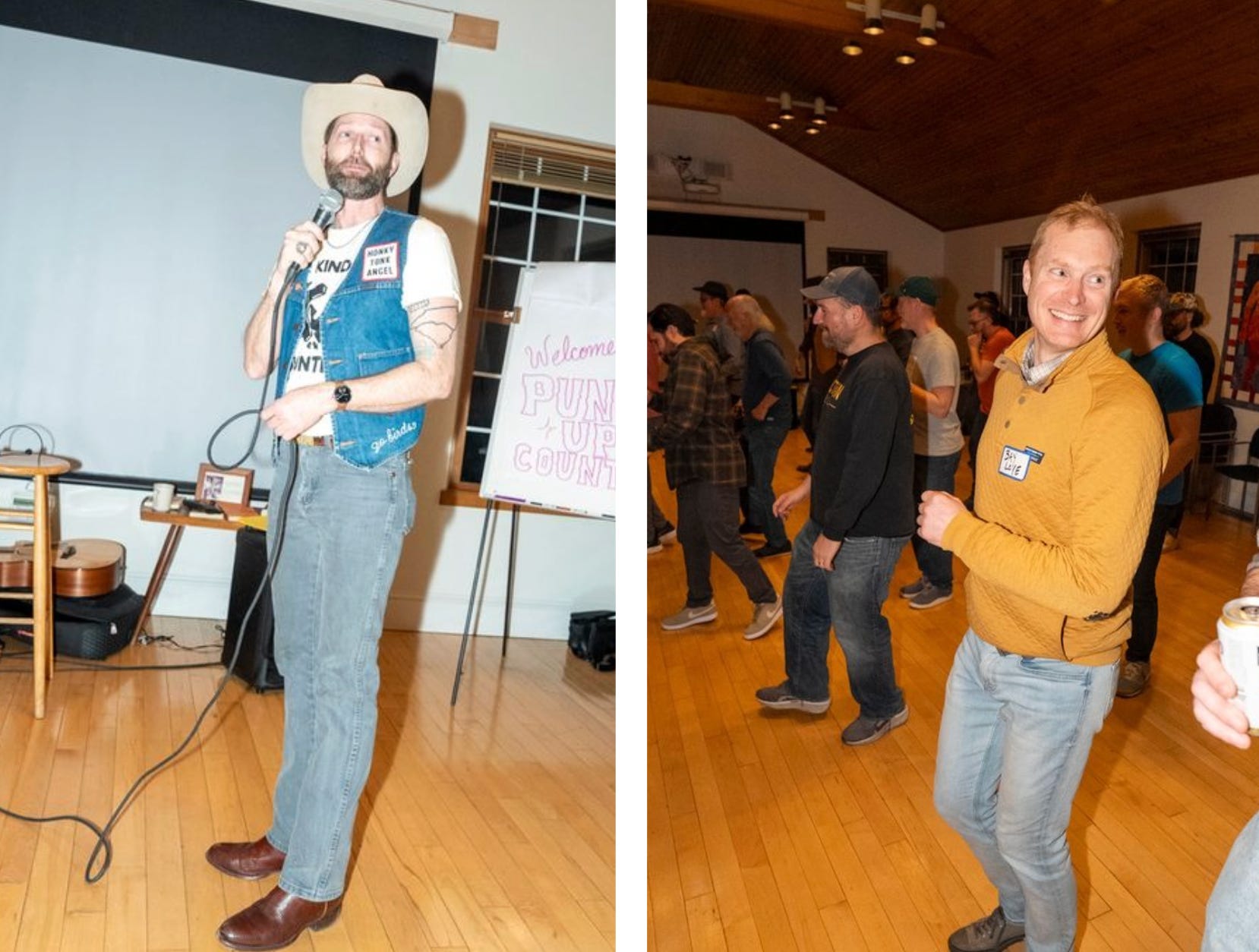
We also built community through song and dance.
Former co-executive director of the Highlander Center, Allyn Maxfield-Steele, helped us remember these movement ancestors by guiding us in the Appalachian folk song, “I Believe in Being Ready”:
Donkey ‘Tonk’ Dover Jr., who uses dancing as a way to explore history and belonging in honkytonk music, led us in a line dance lesson. He drew on Barbara Ehrenreich’s book, Dancing in the Streets, and reminded us of the ways dance and communal festivity had been strategically erased from European life—most of all, from men’s lives—by a capitalist system that sought to turn our ancestors into individualistic, compliant workers.
~
How can we overcome billionaire-backed movements that are investing enormous energy in giving white men a false explanation for their suffering, a set of enemies to blame, and a place to belong? It is not enough to simply tell white men why they are wrong. We have to offer a far more powerful and compelling political home. We have to build up a movement that can provide an understanding of their genuine stake in the struggles of working people across lines of race and gender, communities in which they can learn and grow while never questioning their belonging in shared struggle, and the knowledge that this collective work ties them to a long, beautiful lineage.
At the retreat, I witnessed a growing network of people across the country beginning to figure out how to do this together. What gave me hope was the possibility that, with enough investment and organizing, this emerging ecosystem could someday become a countervailing force powerful enough to reach white men at the scale these times demand.
Thank you for sharing this, David! It definitely gave me an added boost of hope.🙏🏻
Thanks for sharing this experience. Your commentary held space to see this time through a different lens. You are appreciated!